Showing posts with label pininterest. Show all posts

Saturday, 10 November 2012

Advertising and Print Media - Vogue

Advertising is part of the Print Media - to exist most magazines require the income that they receive from adverts. Otherwise the price of the publication will be too high and that would repel the customers. 
New media publishers will not only have opportunities to reach global audiences with multimedia products in real time, but will also be able to completely rethink their relationship with advertisers and audience (Kovarik, B. (2011) Revolutions in Communications: Media History from Gutenberg to the Digital Age, London: Continuum).  
That is exactly what I want to talk about - the relationship between Vogue and advertising. Since its a fashion magazine advertisement place a huge role but with all this new technology and possibilities the way the advertisement is done is changing.  

In the past years the Quick Response Code (QR Code) has become a very popular tool for advertisement. 

Formerly only for industrial uses, they have in recent years become common in consumer advertising and packaging, because the popularity of smartphones "has put a barcode reader in everyone's pocket"[citation needed] for the first time. As a result, the QR Code has become a focus of advertising strategy, since it provides quick and effortless access to the brand's website.[8][9]Beyond mere convenience to the consumer, the importance of this capability is that it increases the conversion rate (that is, increase the chance that contact with the advertisement will convert to a sale), by coaxing qualified prospects further down the conversion funnel without any delay or effort, bringing the viewer to the advertiser's site immediately, where a longer and more targeted sales pitch may continue (http://en.wikipedia.org/wiki/QR_code).

There are of course social media platforms like FACEBOOK, TWITTER, TUMBLR, PINTEREST that I have discussed in previous posts. They are the new tools of marketing. 

But the reason why I decided to talk about advertisement is this website that I found.

Some Swedish students made this interesting advertising project for some company using Vogue as an example.
Basically they were exploring the future of magazine advertisement. I thought it was a very interesting concept that they were exploring. If you just scan, with a smartphone,  a picture of a item featured in  Vogue then your smart phone will go to the items brand website where you could buy the item or explore others. So in a way that would be every girls dream come true - you see something pretty, you buy it, and not you see something pretty, you look for it for the next 2 months.
The development of media of mass communication has gradually seen the decline of print as the dominant form communication and the rise of audio - visual domain (Rayner, P. Wall, P. Kruger, S.2004 Media Studies: The Essentials Resource, London: Routledge). Fortunately print media managed to embrace the audio - visual domain ( Vogue iPad version with mini videos of photo shoot and some images actually moving) but perhaps now Vogue adverts will start to embrace it as well. At least it seems that some one is already trying to promote this concept. It is exciting to see where the digital age is taking us.

Sunday, 4 November 2012

Closer Look at Vogue 2

Previously I looked at Vogue Official Website to understand the transformation that Vogue went through because of the digital revolution. Now I will look on other social media platforms that arrived from the digital revolution  in the past couple of years.

Twitter: 
 

So this is Vogues Twitter page. It can be seen that Vogue homepage and Twitter are very closely connected. All the stories that can be read on their homepage are tweeted or in other words promoted on their Twitter. They also tweet about other topics like food - for example they tweeted about some Halloween cupcakes. Mostly what is tweeted has something to do with the upcoming holidays or what is written on the official website or the magazine, of course some tweets have more of a promotional vibe. The picture shared on this account create a illusion of personal moments of Vogue girls (Vogue employees) being shared with the readers. This gives 800 000 something followers of Vogue the opportunity to be a apart of the posh Vogue lifestyle and be the first to get a glimpse at a new issue of the magazine.
It can also be noted that the tweets are very frequent, there are at least one or two every hour. This supports the idea, that was mentioned previously that print medias (Vogue) content has to be more up to date and the process of getting the content out there needs to be faster. Not to mention that now magazines need to have a discussion with their readers and what better platform for that then Twitter. Out of all the social media platforms at Vogues disposal Twitter is the most interactive one. 

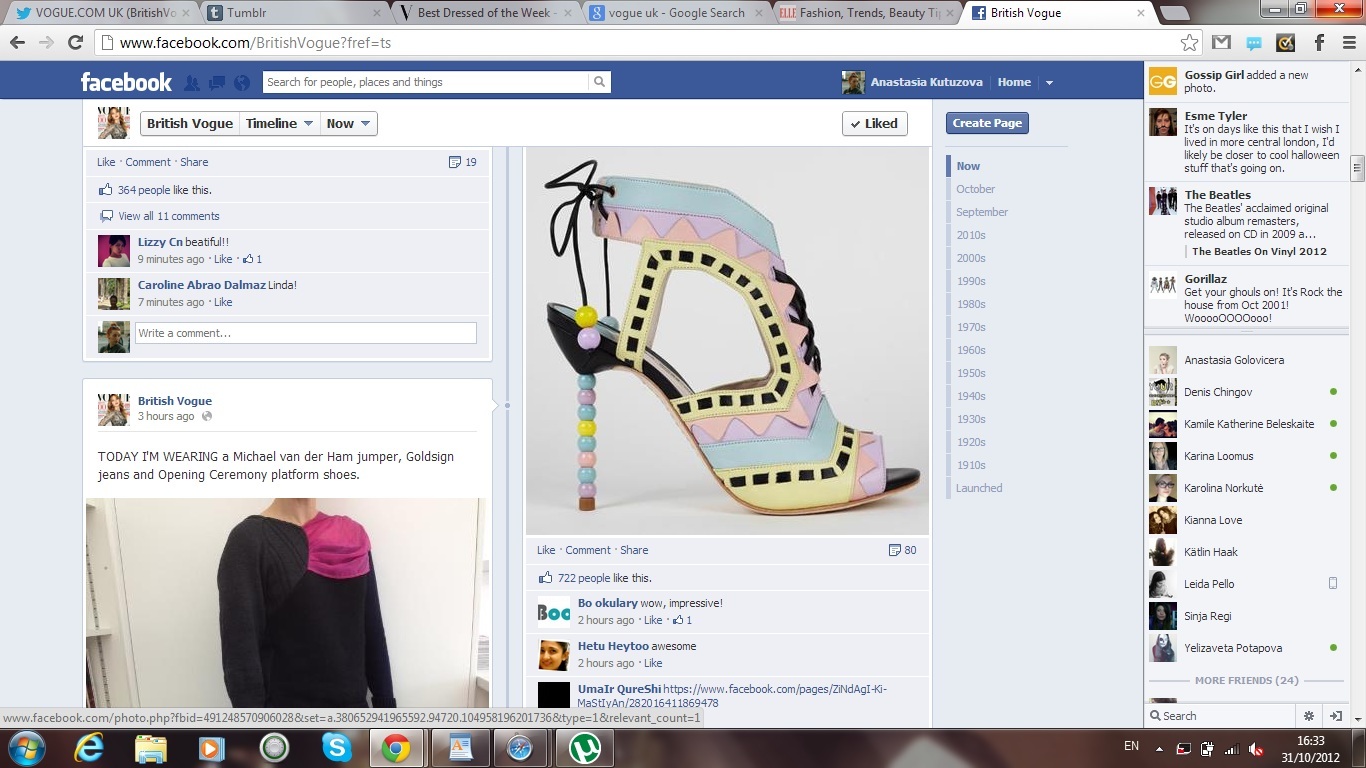
Facebook: 


This is British Vogue Facebook page. It is open to anyone, so that means anyone can like it and have access to the information available on that page. The post on Facebook mostly differ from the tweets that are posted on Twitter. The information on Facebook is not so up to date as on Twitter and perhaps not so interactive. People mostly just press the like button on the post that they like and that where the interaction ends. Of course some more active Facebook users comment and share the post. 
Interesting thing about Vogue Facebook is that you can see all of the important events that have happened in Vogues history  on the timeline.  
The pictures (of wish I don't have a print screen) that are shared on Vogue Facebook and then put into an Album are much more different from those on Twitter but much more similar to those in the magazine. You could say that Facebook is a bit more formal then Twitter and its an extension of the Vogue homepage while as Twitter is more personal and laid back and more promotional, meaning that Vogue Twitter mainly only promotes the magazine,  new places to go out and eat or events that people who aspire to be part of the fashion clique would want to go.  

Tumblr:


This is Vogue Tumblr. Tumblr is basically a collection of images. This social media platform doesn't require much interaction. Of course people have the choice of writing something to the user but mostly people just reblog pictures. On this Tumblr it is possible to find pictures from Vogue from different years. So in a way this website is a archive of images that have been featured in British Vogue. Before the Internet to have access to these pictures it would have meant buying and looking for the old copies of the magazine which would have taken a lot of time and resources.

Pinterest: 


This is a new social media platform that has been gaining popularity on the Internet. Pinterest is similar to Tumblr but instead of just sharing images they are in albums - more like mood boards. So basically Pinterest is an online mood board. Again this is not a place for direct interaction but a place to reblog and like images. Here Vogue images are more organised then on Tumblr but it is also just a archive of Vogue images with some added albums with pictures that perhaps inspire the Vogue girl.


In conclusion it is fair to say that Vogue has expanded its brand and now is available on different social platforms that appeal to a very wide range of people. The content of the magazine is becoming more available, meaning that people now have easy access to images and articles that have been published in Vogue over the years of its existence and also that the readers will have some kind of idea of what to expect from the new issue because of the social media.
Because of the digital age the magazine and its social platforms have become more of a promotional tool. On all of the social medias its written what to buy, what kind of music is cool right now because the fashion editor is "listening" to it or where is the healthiest food place. Because of this change Vogue is now not just merely a fashion "bible", as it has been called in the past years but more of a luxury lifestyle magazine. All in all everything that Vogue has done digitally/ on the Internet has been successful, of course it might be because of  the long history behind the name, but in any case the magazine has been one of the first ones to branch into Internet. 
Personally I really liked the Vogue Website. It was very different to different fashion related website that I have seen previously and that I read everyday. I wish other magazines would work on their online appearance to make it stand out more.